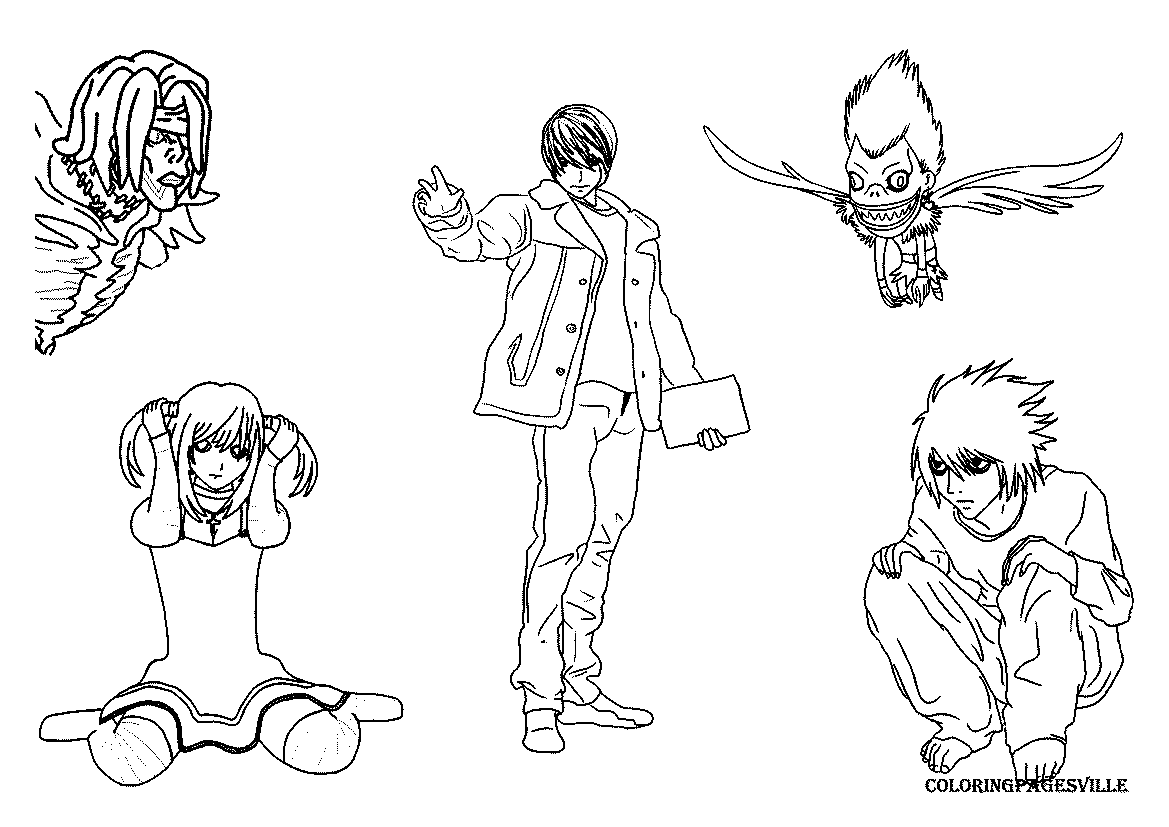
Death Note coloring pages are featuring Light Yagami, L, Misa Amane, Near, Mello, Shinigami and other characters from Death Note animated film. Try to guess who is who.
Death Note is what might happen if you gave a high school student both unlimited power and a knack for drama—and then left him unsupervised with the moral compass of a reality TV villain. When Light Yagami, a rather bright young lad with perhaps a touch too much free time, stumbles upon a notebook that lets him kill anyone by simply writing their name in it, he doesn’t exactly reach for an ethics manual. Instead, he leaps headfirst into an elaborate mission to rid the world of criminals, with a bit too much glee. It’s the kind of show that doesn’t so much explore the boundaries of justice as it gleefully trips over them, offering curious minds a tangled web of "What if?" questions about right, wrong and whatever lies between.
But Death Note isn’t just an ode to dubious decision-making; it’s a fine study in how absolute power doesn’t just corrupt—it absolutely insists on a theatrical spiral of questionable choices. Light takes on the role of judge, jury and executioner, a role he seems to believe looks good on him but mostly reveals just how complicated justice can be. The more his ego balloons, the blurrier those lines between "hero" and "villain" become, leaving viewers (and any thoughtful teens watching) to ponder whether anyone could—or should—take matters into their own hands with quite so much enthusiasm.
Then, as Light’s quest descends into a rather dramatic power trip, viewers get a front-row seat to his growing psychological turmoil. In watching his tale of moral acrobatics unfold, it becomes clear that the weight of wielding life and death isn't all it’s cracked up to be, especially when one’s self-image as the world’s savior starts slipping a bit. In the end, Death Note doesn’t preach—it just hints, in the way only a darkly amusing anime can, that maybe ethics classes should come before finding magical notebooks.
Death Note is what might happen if you gave a high school student both unlimited power and a knack for drama—and then left him unsupervised with the moral compass of a reality TV villain. When Light Yagami, a rather bright young lad with perhaps a touch too much free time, stumbles upon a notebook that lets him kill anyone by simply writing their name in it, he doesn’t exactly reach for an ethics manual. Instead, he leaps headfirst into an elaborate mission to rid the world of criminals, with a bit too much glee. It’s the kind of show that doesn’t so much explore the boundaries of justice as it gleefully trips over them, offering curious minds a tangled web of "What if?" questions about right, wrong and whatever lies between.
But Death Note isn’t just an ode to dubious decision-making; it’s a fine study in how absolute power doesn’t just corrupt—it absolutely insists on a theatrical spiral of questionable choices. Light takes on the role of judge, jury and executioner, a role he seems to believe looks good on him but mostly reveals just how complicated justice can be. The more his ego balloons, the blurrier those lines between "hero" and "villain" become, leaving viewers (and any thoughtful teens watching) to ponder whether anyone could—or should—take matters into their own hands with quite so much enthusiasm.
Then, as Light’s quest descends into a rather dramatic power trip, viewers get a front-row seat to his growing psychological turmoil. In watching his tale of moral acrobatics unfold, it becomes clear that the weight of wielding life and death isn't all it’s cracked up to be, especially when one’s self-image as the world’s savior starts slipping a bit. In the end, Death Note doesn’t preach—it just hints, in the way only a darkly amusing anime can, that maybe ethics classes should come before finding magical notebooks.
Add comment