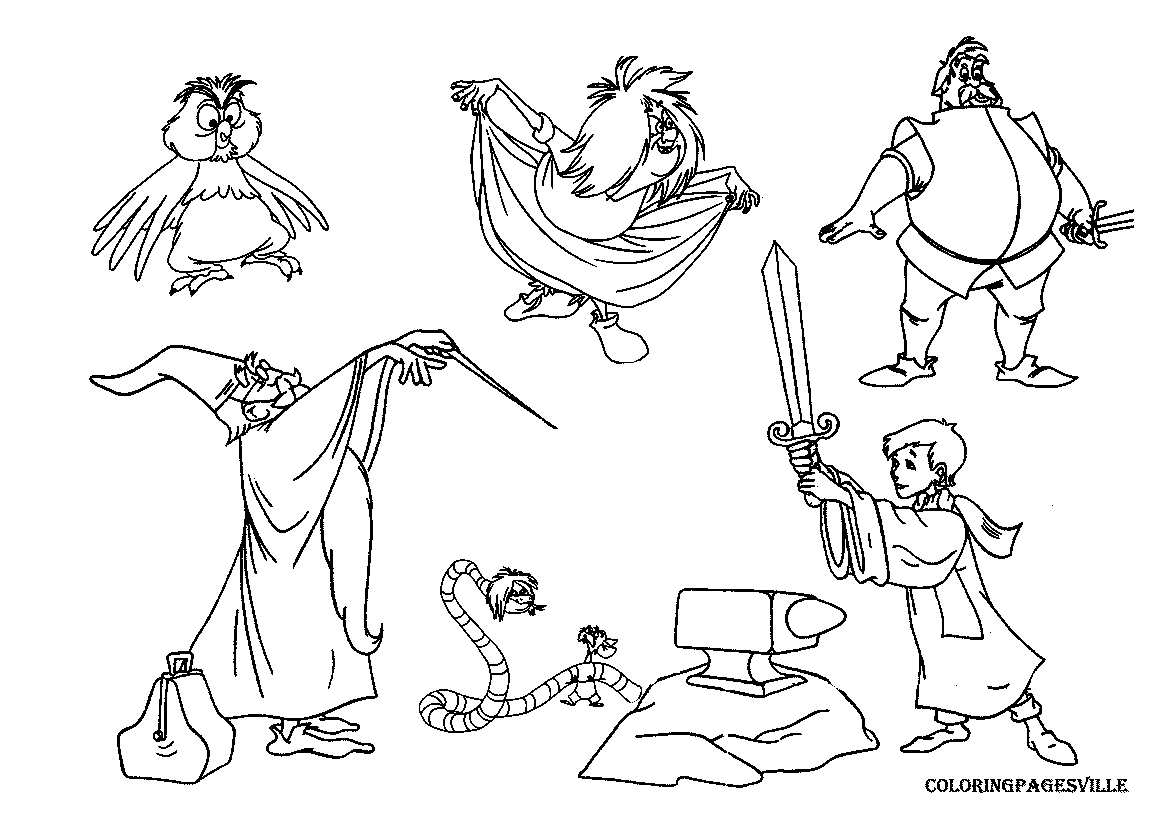
The Sword in the Stone coloring pages are featuring Arthur/Wart, Merlin, Madam Mim, Archimedes', Sir Ector, Sir Kay, Sir Pellinore, Black Bart, The Wolf, The Little Girl Squirrel and other characters from The Sword in the Stone animated film. Try to guess who is who.
The Sword in the Stone tells the peculiar and thoroughly improbable tale of young Arthur, an ordinary lad with an extraordinary fate, who is somehow destined to pull a sword from a stone and become King of England. But rather than bothering with the usual royalty-raising strategies (fancy tutors, fencing, etiquette), Arthur, or Wart as he's rather unfortunately known, finds himself in the dubious care of Merlin—a wizard with the punctuality of a broken alarm clock and the wardrobe of a second-hand spell shop.
Now, Merlin's idea of education is not the usual reading, writing and knightly knighting business. No, Merlin believes in learning by turning his pupil into fish, squirrels and other wildlife, under the broad philosophy that survival skills in the pond and the forest will teach one a thing or two about the power of curiosity, which (according to Merlin) is much more useful than being able to distinguish a salad fork from a jousting lance. Children watching Wart narrowly escape becoming some predator’s lunch will no doubt gain an appreciation for cleverness and possibly an enduring respect for biology.
Yet at the heart of all this madcap metamorphosis is a remarkably sensible message: that greatness doesn’t spring from bulging muscles or bombastic proclamations but from quiet courage, resilience and a bit of kindness—a quality in which Merlin is occasionally deficient but Wart has in droves. By the time he finally grasps that sword, kids will have learned, somewhere between the squirrel-romance debacle and the literal fish-out-of-water scenarios, that the real magic lies in the bravery of facing life head-on, even if life sometimes comes at you with a beak or a pair of claws.
The Sword in the Stone tells the peculiar and thoroughly improbable tale of young Arthur, an ordinary lad with an extraordinary fate, who is somehow destined to pull a sword from a stone and become King of England. But rather than bothering with the usual royalty-raising strategies (fancy tutors, fencing, etiquette), Arthur, or Wart as he's rather unfortunately known, finds himself in the dubious care of Merlin—a wizard with the punctuality of a broken alarm clock and the wardrobe of a second-hand spell shop.
Now, Merlin's idea of education is not the usual reading, writing and knightly knighting business. No, Merlin believes in learning by turning his pupil into fish, squirrels and other wildlife, under the broad philosophy that survival skills in the pond and the forest will teach one a thing or two about the power of curiosity, which (according to Merlin) is much more useful than being able to distinguish a salad fork from a jousting lance. Children watching Wart narrowly escape becoming some predator’s lunch will no doubt gain an appreciation for cleverness and possibly an enduring respect for biology.
Yet at the heart of all this madcap metamorphosis is a remarkably sensible message: that greatness doesn’t spring from bulging muscles or bombastic proclamations but from quiet courage, resilience and a bit of kindness—a quality in which Merlin is occasionally deficient but Wart has in droves. By the time he finally grasps that sword, kids will have learned, somewhere between the squirrel-romance debacle and the literal fish-out-of-water scenarios, that the real magic lies in the bravery of facing life head-on, even if life sometimes comes at you with a beak or a pair of claws.
Add comment